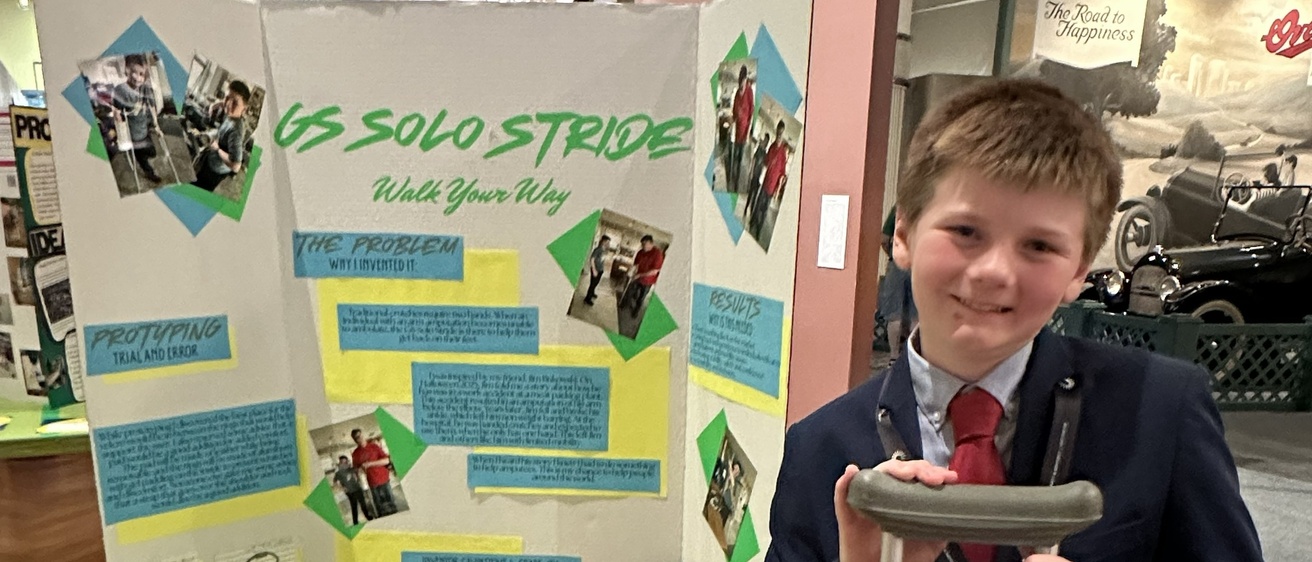
The invention process is at the heart of Invention Convention—Invention Convention Worldwide has updated its judging rubric to better align evaluation with the way students invent. The changes will flow through to Iowa's state finals and regional competitions, giving educators and students a clearer framework for understanding what judges are looking for throughout the invention journey.
The updated rubric shifts the focus from a collection of individual project components to a more intentional evaluation of the full invention process: identifying a problem, understanding it, developing ideas, designing, building, testing, and communicating the solution.
For educators preparing students for the 2026–27 school year, this means there is a new way to think about how students prepare for competition.
The Big Change: 10 Categories, 10 Points Each
The new rubric consists of 10 categories worth 10 points each, for a total of 100 points.
| New Rubric Category | Points |
|---|---|
| Identifying | 10 |
| Understanding: Problem Analysis | 10 |
| Understanding: Existing Inventions (Originality) | 10 |
| Ideating | 10 |
| Designing | 10 |
| Building | 10 |
| Testing | 10 |
| Communicating (Written): Logbook | 10 |
| Communicating (Visual): Display Board, Prototype | 10 |
| Communicating (Verbal): Live Presentation with Q&A | 10 |
| TOTAL | 100 |
From Project Rubric to Invention-Process Rubric
The previous rubric evaluated a combination of invention skills, project components, and supporting considerations. The new rubric reorganizes those elements around the actual process students experience as they develop an invention.
| Previous Rubric Categories | Points | Updated Rubric Categories | Points |
|---|---|---|---|
| Identifying & Understanding | 10 | Identifying | 10 |
| Understanding: Problem Analysis | 10 | ||
| Originality | 15 | Understanding: Existing Inventions (Originality) | 10 |
| Ideating | 10 | Ideating | 10 |
| Designing & Building | 10 | Designing | 10 |
| Building | 10 | ||
| Testing & Refining | 10 | Testing | 10 |
| Market Research | 5 | Incorporated into updated category | |
| Environmental & Societal Impact | 5 | Incorporated into updated category | |
| Logbook | 10 | Communicating (Written): Logbook | 10 |
| Display Board | 5 | Communicating (Visual): Display Board, Prototype | 10 |
| Prototype or Model | 5 | Incorporated into updated category | |
| Video Presentation | 5 | Required for nationals only; no points | |
| Live Presentation with Q&A | 10 | Communicating (Verbal): Live Presentation with Q&A | 10 |
The total remains 100 points, but the distribution is changing to better reflect the invention process.
Takeaway for Educators
For teachers, mentors, and coaches, the biggest takeaway is: Teach the process—not just the final product. Students will have opportunities to demonstrate what they have learned at every stage of their invention journey. The new rubric can be viewed as a roadmap, following the steps of the invention process.
This means brainstorming, research, sketches, failed attempts, design changes, prototype development, testing results, and reflection can all become meaningful evidence of student learning.
Originality
Students should investigate what has already been invented and be able to explain how their invention is different. This creates a more authentic approach to originality. Before claiming an idea is new, an inventor needs to understand what already exists.
Students should be prepared to answer questions such as:
- What solutions already exist for this problem?
- What did you learn from researching those solutions?
- How is your invention different?
- What makes your approach unique?
- Why is another solution not enough?
Market Research and Environmental & Societal Impact
Two categories from the previous rubric—Market Research and Environmental & Societal Impact—will no longer receive their own dedicated point values. That does not mean these topics disappear from invention education. Instead, they can naturally become part of students' broader problem analysis, research, design, and decision-making.
Inventors need to be able to explain their thinking—not just build something.
Video Presentation
The video presentation requirement is changing, but it is not going away. Students competing at the national level will still be required to submit a video presentation. The difference is the video will no longer be worth 5 points on the competition rubric. Instead, the video will be used as part of the national awards process.
| Past Rubric | Updated Rubric | |
|---|---|---|
| Video required for nationals | Yes | Yes |
| Video worth rubric points | 5 | No |
| Video used for awards | Yes | Yes |
For Iowa educators, this means the video remains an important national requirement for students who advance, but it is no longer one of the ten scored categories. For state, a video presentation is NOT REQUIRED.
Impact to Iowa Invention Convention State Finals
The updated rubric will impact the Iowa Invention Convention State Finals beginning in 2027. This gives Iowa educators an opportunity to begin preparing students for the updated approach during the 2026–27 school year. The changes are ultimately designed to make the competition a 1:1 with the invention process and what students are already learning.
About the Jacobson Institute and Iowa Invention Convention
The Iowa Invention Convention provides hands-on learning that connects classroom concepts to real-world challenges. Through the process of identifying problems, developing solutions, and presenting their ideas, students build critical thinking, confidence, and collaboration skills.
The Jacobson Institute continues to expand access to invention education through partnerships with schools and communities statewide, ensuring more students can explore their ideas and bring them to life. Click to get involved in Iowa Invention Convention.
The Jacobson Institute is the K-12 outreach arm at the University of Iowa, focused on innovation, invention, and entrepreneurship education.